Posts Tagged ‘advertising’

A single metric to compare different publications

Monday, April 1st, 2013

You’ve received quotes for advertising from two publications or websites; one wants to charge $150 and the other $350. How do you know which is the better deal?

Creating an apples-for-apples comparison between different publications is difficult because it involves so many variables.

The most common calculation for this job is cost-per-thousand (CPM), which measures the amount of money it takes to reach 1,000 people. You can use it for any medium – broadcast, print and online. (But it won’t hold up if you try to compare one medium against another).

Here’s the formula:

CPM = Rate/(Circulation x .001).

So if an ad costs $250 and the publication’s distribution is 8,000 copies, the CPM is $250/8, or $31.25.

It’s a simple calculation, and it lets you compare the rates of different publications with different circulation sizes.

But it has limitations.

For instance, it only works when comparing rates in the same media channel – print v. print or online v. online. That’s because the economics to produce different media – and the results they generate – are so different. Even when using it to compare two similar offers, be aware of these complications:

Ad size: CPM for a half-page ad will be higher than for a quarter page ad in the same publication.

Frequency. The more ads you buy, the lower the price will be for each. That means a single publication will have a different CPM for every ad unit and every frequency rate. The Heights Observer, which offers a pretty typical rate structure, has 60 different CPMs depending on the size of the ad and the number of insertions you buy.

Page size: Move vexing, a quarter-page ad in one publication (The Wall Street Journal, for instance) may be much larger than a quarter-page ad in another (i.e. Reader’s Digest).

That’s why it’s helpful to take CPM a step further – CPM per square inch (CPM/i²).  It’s the cost you pay for each square inch of space to reach 1,000 people. Here’s the formula:

CPM/(height x width)

This will get you closer to that apples-for-apples comparison between different publications. It’s still not perfect. The bigger the differences between two publications, the less relevant CPM/i² will be. But in such cases, it may be the only tangible link for comparing  disparate ad products.

So what’s the best way to use CPM and CPM/i² to make advertising decisions efficient and painless?

Step 1: Decide which publications you’re interested in, based on who they reach and how you feel they’ll work for you. Then look up or request their rates.

Step 2: After getting past the sticker shock, decide how much you want to spend per week, month or year. (Plan to advertise consistently over an extended period. It works best when treated as a long-term investment.)

Step 3: Select ad units in each publication that fit within your price range. Include any extra charges for color. If you can afford a full-page ad in one publication but only a small ad in another, that’s OK. CPM/i² should become a smaller part of your decision but it’s still instructive in your evaluation.

Step 4: Using the same frequency rate (i.e. if you use the 12x rate in one publication, use the closest thing to a 12x rate in every publication), calculate CPM/i².

Now you can evaluate the pricing with confidence, knowing this is as close as you’ll get to an apples-for-apples comparison.

In the end, CPM/i² is only one metric; it should never be the your only consideration. Such factors as a publication’s acceptance among readers, the relevance of its content and its customer-friendliness are at least as important.

Your gut may have to take you the rest of the way.  But you’ll know there is at least some science behind the decision.

Image courtesy of Suvro Datta/FreeDigitalPhotos.net


Advertising 101: Frequency v. size v. color

Thursday, February 28th, 2013

If money were easy to come by, every ad would run in every issue as a full page. But a buck is hard to make and compromises are a fact of life.

So what’s more important: running a big ad or running an ad often?

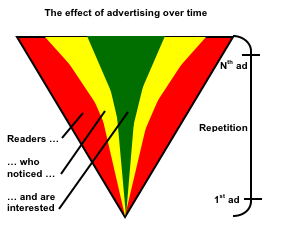
Advertising – any advertising, whether print, online or broadcast – works best through repetition. Look at it this way: You know that if you send a direct mail piece or a mass e-mail, only a small percentage of recipients will actually open it.

Advertising offers better percentages, but the concept is the same; 10,000 people may read a publication, but only some of them will notice any given ad.

Conventional wisdom in the media industry says it takes 7 impressions to attract a reader’s attention. I’ve never actually seen any research to support this.

But I think I know where it comes from. I’ve been involved with research at various magazines over the years that indicated 10% to 20% of readers were able to positively identify whether a specific ad ran in the most recent issue. Larger ads generally increased reader recall.

From that you can conclude an ad needs to run 5-10 times before everyone in the publication’s circulation can be assumed to have noticed it.

(A statistician could find about a dozen things wrong with this statement. And the research will vary widely depending on the publication, its audience, the number of pages and advertisements it contains, and a host of other factors. So please take it in the general spirit intended).

But just because people see your ad doesn’t mean they are currently interested in what you’re selling.

For instance, regardless of how large your ad is, you’re not likely to sell carpet to someone who’s renting an apartment month-to-month.

But when that person buys a house and starts thinking about upgrading the floors, you want him to have noticed your ad in the past; you want him to go looking for your ad in the publication’s current issue.

Therefore, successful advertising isn’t just about getting noticed. It’s about 3 things:

  1. Getting noticed
  2. Being remembered
  3. Being there at the right time

That’s why I recommend frequency as the higher priority in advertising. Frequency is a factor in all three things while size is only a factor in No. 1. I’d confidently predict better results over time for someone who runs a smaller ad in every issue than a larger ad sporadically.

Further, spending too much on an ad can harm its chances of success. How?

If you sell houses for a living, a single commission can pay for a year’s worth of large ads. Selling a home is a big deal involving big money, and a big ad to discuss it seems reasonable.

But if you sell haircuts or ice cream cones your ad needs to attract a lot of customers just to cover its cost. The larger the ad, the better it has to perform just to pay for itself.

If you run a hair salon, how many strangers on the street would you have to approach and talk to before one of them says, “I was just thinking of getting my hair done and I’m not satisfied with my current stylist. I’ll head over there right now.” Would it be 100? 200?

Run through the math: If a publication has 10,000 readers, perhaps 1,000 of them (1 in 10) will take note of your ad the first time it runs. If 1 in 200 decides at this particular moment to abandon her old hair salon and try yours, that means it would be unrealistic to expect more than 5 people to walk through the door as a result of the ad. What is a reasonable amount to spend for those 5 people? And because this is an inexact science, what’s a reasonable amount to spend if the first time the ad runs, it’s only 1? Or none? (As in the bottom of the pyramid in the graphic above.)

So be realistic about how much business the ad is going to bring in – especially in the first few months – and don’t sign up for more than you can afford to spend out of existing cash flow. And expect the results to improve gradually over time, until a steady flow of people tells you they’ve noticed your ad.

There are moments when these rules of thumb may not apply. For instance, if you’re promoting an event or have some other short-term message, then it’s most important that your ad gets noticed right away by as many people as possible. That’s when you want to buy a large ad and negotiate (or pay for) the best positioning you can get.

Color too plays a role. Spending extra as needed for color will help get your ad noticed – though it has a lesser impact than size. Also, color probably has more impact on the way your message is perceived than on whether it’s noticed at all.

The small business owners who tend to be happiest with their advertising are those who buy a smallish ad, spend time developing its look and its message, and then commit to running it month after month, year after year.

Advertising works. It’s not so much an expense as an investment. So invest wisely and consistently. Do it in a way that you can afford to give it time to work. If you do, it will make your business better.

Image courtesy of Graur Razvan Ionut/FreeDigitalPhotos.net


Your business card is not an ad

Friday, November 30th, 2012

Work boots are like soccer shoes in the sense that they both provide a protective covering for your feet. But if you play soccer or work in a steel plant, they are anything but interchangeable.

Your marketing materials are purpose built in the same way. A brochure isn’t interchangeable with a frequent buyer’s card any more than work boots are interchangeable with soccer cleats.

People who run their own small businesses are hard-working and busy. They typically seek to leverage time and money by applying one solution to as many problems as possible.

Small publications take advantage of that tendency by creating ads that are the same size as a standard business card. Business owners don’t have to think or spend to design an ad, and the publication gets a quick signature on a contract.

But just because it’s cheap and easy doesn’t mean it’s smart. In fact, it’s usually a waste of money. Business cards and advertisements are simply designed for different work.

The job of business cards is to make it easy for people to reach you. And that’s all they does. They work because you hand them out to people who have already expressed an interest in what you do.

On the other hand, the job of an advertisement is to help people decide if they’re interested in what you do. It has to tell people what you do, and how you do it better (or differently) than others. It also may need to include a coupon or special offer of some kind to allow you to track results. And, of course, it must include at least a few critical bits of contact information.

If you plan to advertise, spend time thinking about how your ad must differ from your business card in order to really sell your product or service. If you’re not able to make that commitment, then find another way to invest in your business.

Because running a business card as an ad probably won’t generate results. But it will indicate that you ‘re someone who thinks it’s a good idea to play soccer in work boots.

Image courtesy of Luigi Diamanti/FreeDigitalPhotos.net

The economics behind the media meltdown

Friday, September 21st, 2012

What really happened that caused traditional media to shrink so much over the past decade – and why are so many still struggling to come back?
That’s the subject of this presentation, which I’ve given several times over the past few years.


Wants vs. needs? You’re selling both

Tuesday, April 24th, 2012

Seth Godin, one of the best marketing bloggers I follow, says wants and needs are often confused. He writes:

That pays off for any marketer that has persuaded his market that they need what he sells. It backfires when those ‘needs’ are seen for what they actually are–luxuries.

I agree with Godin in both his point and his brevity. But in being admirably concise, he omits a noteworthy nuance. People are more eager to buy things they want than things they need. They’ll go to great lengths to pay the lowest price possible for actual needs – stuff like medicine, groceries, industrial consumables. But they’ll happily spend more on things they want – think wine, golf clubs, a redecorated office.

The point? While Seth Godin is correct that you’ll improve sales by persuading people you can fill a need, you’ll lubricate the sales process and increase pricing margins by convincing people that your product is also something they want.

As evidence, consider:

  • Dell v. Apple
  • Toyota Yaris v. Mini Cooper
  • Emerson audio equipment v. Bose

There’s a lesson for your marketing in that knowledge too.

The time has passed for revenue-enhancing digital products

Friday, October 21st, 2011

A small B2B media company contacted me to talk about enhancing revenue by adding some new digital products to its portfolio. The company already offers a digital edition, business directory, email newsletters, web-seminars and a number of other digital B2B staples. Non-monetized but just as important, it has a reasonable Twitter following, a large group on LinkedIn and a Facebook page that is basically just a placeholder.

I’m sure there are more products the company could implement. It doesn’t have any mobile offerings to speak of, and its website represents first-generation internet thinking – a source of information but not of engagement and interaction. With a little bit of study and a few billable hours I could have made some recommendations.

Here’s what I told them instead: The opportunity to increase revenue by adding digital products has largely passed, and simply adding new products will probably hurt the business by:

  • spreading the editorial staff even thinner;
  • raising digital development costs;
  • over-running the sales force’s competence;
  • stressing customers, who don’t have more money to spend on new products and will be forced to decide which products to support and which to ignore.

In essence, trying to invigorate the company by adding more digital products is just going to lead to more fatigue for everyone – and at best provide only incremental revenue gains.

The real opportunity – and the only real option – is to use digital tools to increase the organization’s footprint and prominence.

Here’s the argument:

In B2B media, ad revenue and unit yields have been stagnant for a decade, and there is no reason to think that’s going to change for the better. As hard costs continue to rise, print circulations have been on a forced retreat. Publications that have maintained controlled circulation levels are doing so by cutting in other areas or – more likely – by winning market share and profits from other, lesser competitors. Neither is sustainable.

Given that it’s not economical to add print readers, the real value of a digital strategy is to present the brand to new people – either by expanding outside the magazine’s traditional market (taking a step upstream, toward the advertisers’ suppliers, for example) or its traditional geography (i.e. international).

That doesn’t mean simply launching a digital or iPad edition. These are passive – cool media in Marshall McLuhan’s lexicon.

But extended audiences demand hot media. They need to be actively engaged; they need learn for themselves how a media brand is valuable to them. Engagement at that level means creating a different kind of relationship based on interaction with community, expansiveness of content, and flexibility in the way content is applied. These are the strengths of digital tools – when those tools are skillfully and strategically applied.

In the real world, it probably means a pretty significant website overhaul and, more significantly, redeployment of staff and restructuring of sales compensation.

Editors have to stop thinking in terms transferring knowledge from experts to the readers – instead becoming moment-to-moment conduits for peer-to-peer communication. Less like network news anchors and more like a highly specialized cruise directors.

Sales strategy has to evolve too. It’s less about products and more about platform – how the media brand provides a fluid and organic conduit between the advertiser and the market.

These are not small changes to make, and this is not a short-term project. But it represents the difference between relevance, growth and prosperity on one hand; and retreat into a niche position or extinction on the other.

Advertisers will always go where the people are

Wednesday, June 8th, 2011

Alan Mutter, who calls himself the Newsosaur and whose opinions on the news business I deeply respect, points out that newspapers are now well into their sixth year of declines in advertising demand. In a recent blog post, he noted that annual newspaper sales hit $10.7 billion in 2006 – and now stand at $4.3 billion, about the same level as 1983. And they continue to drop.

While the drop in advertising isn’t new for newspapers, it hasn’t always been their No. 1 problem. Credit for that goes to the systemic and ongoing declines in circulation. Newspapers are simply less relevant across society than they once were.

But the dynamic behind shrinking advertising is different; it’s more like the experience of magazines – especially business-to-business – over the past decade.

I’ve written about the reasons behind the loss of advertising for magazines, and I’m not alone. The issue isn’t that advertising has ceased to work; I don’t believe that’s the case now, nor do I foresee the day when it is.

The issue is that other things now work better. And by other things, I really mean one other thing: social media.

First, more people are involved in social media than in any other media channel. If you lump together YouTube, Facebook, LinkedIn, Slideshare and the thousands of other social media websites, day-to-day participation is as broad as any other media channel.

Further, in most cases participation is free – even for the marketers, at the most basic level.

Further still, results are always measurable.

The equation is really simple: Marketers who are pulling back on their traditional advertising are merely following the lead of other marketers. And those who are not actively involved in social media are negligent. Marketers need to be where the people are, so they simply aren’t going to ignore a media channel that has so quickly attracted a large percentage of the world’s population.

I could predict that advertising revenues are going to continue their decline for newspapers, because consumer advertisers are now discovering what business-to-business advertisers learned several years ago: With social media, you can  (and should) become your own publisher – developing an audience and serving it with meaningful, interesting and helpful content.

That doesn’t mean newspapers, magazines or any other type of print media are doomed. But newspapers of the future will be very different than they were just six years ago. The sooner they figure out how to unhitch their fortunes from advertising, the better off they’ll be.

So much to do that nothing gets done

Wednesday, May 4th, 2011

Many small business owners are not marketers. They’ll tell you as much.

People start their own business in order to do what they love and do well. Marketing becomes a necessary evil.

For many, writing is a chore. Or databases are a mystery. Or blogging takes too much time. Social media creates an uncomfortable blend between business and personal. Networking is superficial. Advertising is too expensive and doesn’t work quickly. Public relations is a crapshoot.

It’s altogether too time-consuming, too hard, too expensive. There’s so much marketing work to do that  nothing gets done. And it’s easy to justify, because word-of-mouth is the thing that works the best anyway. But word-of-mouth isn’t real marketing; it’s luck. And while I’d rather be lucky the good, the real winners are both.

Aside from being under-capitalized, marketing paralysis may be the most common affliction among small businesses. There is a lot to know about marketing and too many easy reasons not to get started.

But marketing is now more accessible to small businesses than it’s ever been. Marketing rarely comes for free, but it’s possible to start marketing seriously without risking thousands of dollars like you had to do 10 years ago.

So here’s an idea: Try one thing. Instead of getting overwhelmed by all there is to learn about marketing, try choosing one marketing activity and focusing on it until you’re proficient – or at least comfortable.

What should you do first? I’d advise doing the activity that interests you most; you’re more likely to find the joy in mastering it.

But if you insist on being pointed in the right direction, swallow your pride and jump onto Facebook. Why? It’s a tool that can allow you to reach 1 out of 2 people in the United States – for free. If you coughed up $3 million to advertise on the Superbowl you wouldn’t reach that many people. Facebook is, simply, the largest media outlet in the world. And you can get started without spending a nickel.

What do you do on Facebook? Start by building a profile for your company, and then explore and experiment. We can discuss it in more detail another time. What’s important is that you do something. Anything.

How big is mobile computing? Really big.

Tuesday, June 8th, 2010

Mary Meeker of Morgan Stanley made the following presentation at a recent meeting of technology wizards and gurus. (Notably she got the name of the event wrong; it’s the CN Summit.)

There’s a breadth of information here, ranging from adoption of mobile technologies to the potential for mobile advertising to the investment outlook for companies in the business.

The big takeaway for me is how it underscores the increasingly reasonable-sounding claims that mobile computing will change how we think about computing; and, no less, how important it is for media companies of all sizes to recapture their audiences on the small screen.

ABC audit bureau dives into digital head first

Monday, April 26th, 2010

ipad2For those – and there are many – who say the iPad won’t save publishing, here is evidence that the Little Tablet that Could might be more powerful than they expected.

ABC, the leading auditor of consumer and paid periodical circulation, has built a service that allows media to count readership across  multiple electronic platforms: apps, e-readers and mobile browsers.

Ordinarily slower than honey from the fridge, the audit bureau’s speed to provide meaningful data across the fast-emerging new-media platforms speaks to the urgency of its customers. The data means media will be able to sell advertising for new online formats almost as fast as they develop. That alone will hasten the already hurried development of unique offerings for smart phones, mobile websites and the iPad (as well as the fleet of act-alike products that others will inevitably produce).

It’s important because it’s a stay of execution for the advertising-based business model on which virtually all media rely but which has so far resisted the digital transition.

Why give the iPad credit for this? Since its introduction just a month ago, the conversation about mobile media has changed dramatically – as have reader habits.  Powered by the app, consumers are suddenly willing to buy subscriptions for online content,  Google has been declared a declining power in big media’s pursuit of traffic, and at least one of the major audit bureaus has been shaken to innovate. All because iPad provides a different user experience than any previous device.

I’m not ready to declare that the iPad is going to save publishing-as-we-know-it. But I’m pretty sure it will be right in the middle of publishing-as-it-comes-to-be.